
Writing With: A Seven-Week Course Taught by the North Sea Poets
February 4, 12:00 AM – March 21, 12:00 AM EST
£250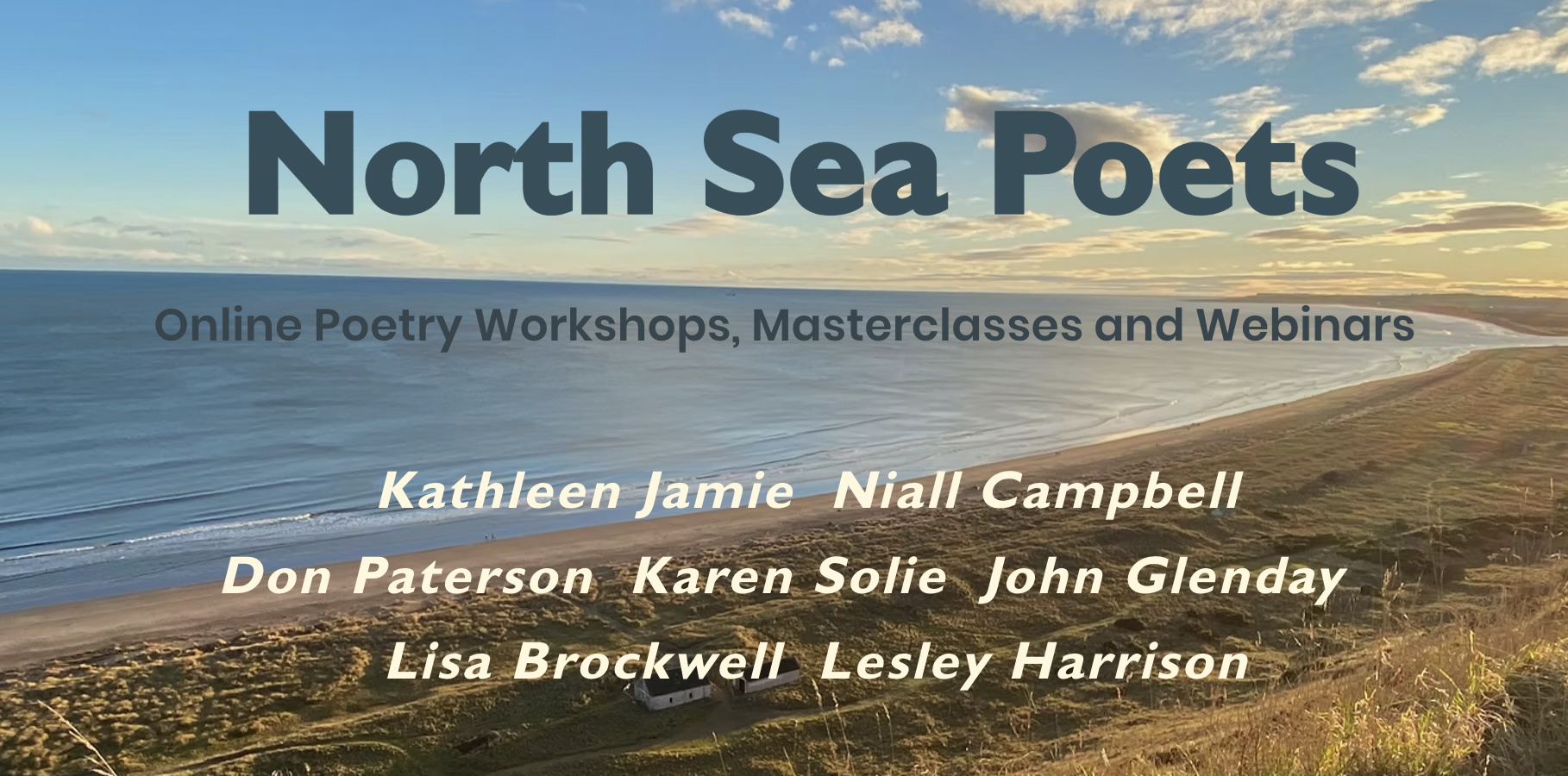
A series of seven classes delivered weekly by members of the North Sea Poets. Classes will run between 90 minutes and two hours long, and students will have an opportunity to directly interact with the tutor through a Q&A at the end of the session.
This workshop series is suitable for both experienced and emerging writers.
The Dates:
Wednesdays
7:30-9:30pm GMT
The course will run between 4th February – 18th March 2026.
OR
Saturdays
11am-1pm GMT
The course will run between 7th February – 21st March 2026.
The Details
North Sea Poets Spring Course – ‘Writing With …’
The sequence of the workshops will be confirmed soon.
📅 Wednesdays, 4th February – 18th March 2026, OR Saturdays, 7th February – 21st March 2026
⏰ Wednesdays, 7:30-9:30pm GMT, OR Saturdays, 11am-1pm GMT
Writing with Work – Karen Solie
‘You know what work is,’ writes Philip Levine, ‘although you may not do it.’ Levine isn’t talking about ‘the work’ of the poems. He’s talking about what most of us need to do to survive. In this session, we’ll read poems from the shop floors and the offices, the professions and the trades, poems that encourage the full range of our vocabularies and our knowledges, that affirm that the language of life is the language of poetry. In brief writing experiments we’ll explore our relationships to daily grinds past and present, and in the process discover new possibilities for bringing the many selves that work creates together in our writing.
Writing with Beasts – Kathleen Jamie
If we have been painting with animals since the Upper Paleolithic – and sculpting and making music with and about animals – is it credible that there wasn’t also some kind of poetry? As hunter-gatherers, our speech would surely have been rich with animal similes and metaphors, proverbs and wordplay. What’s changed, in 40,000 years? In this session we will look at some contemporary poems which feature animals, and have a think about how we observe them nowadays, how they enter our modern lives, and our ever-changing moral relationship with our fellow species.
Writing with Windows – Lisa Brockwell
‘There is more than glass between the snow and the huge roses.’ What are we doing when we look through a window? All poems are windows: framing and establishing a point of view through which to contemplate the world outside our subjectivity and let in some light – or, indeed, some darkness. We’ll explore the cinematic in poems, and the way windows act as thresholds, letting us stay put while the mind’s eye roams from interior to exterior, or through the veil and into the otherworldly. We’ll read some wonderful poems which feature windows: MacNeice’s ‘great bay-window’ in ‘Snow’, of course, but many others too – on trains, on planes, at home, in hospital – and discuss some exercises to help us stare more fruitfully from our own.
Writing with Misplaced Things – Niall Campbell
I have long admired Jane Hirshfield’s elegantly simple poem ‘A Chair in Snow’. In it she states that ‘a chair in snow is always sad’. The chair is the ultimate domestic item, meant to hold us, our books, and clothes, the details of human life. Taken from its regular environment, it is transformed into a little totem of neglect or abandon, by holding what it shouldn’t – snow. This workshop will look at what opens up when we place things where they don’t naturally belong. Dandelions will appear in house gutterings, a harp might play in the coalshaft of a mine – or a chair will stand in the falling snow.
Writing with Jack Gilbert – Don Paterson
There’s so much to learn from the work of Jack Gilbert: from his sheer ‘interestingness’ to his ability to astonish and be astonished; from the ease of his language to his avoidance of easy solutions; and from what we might call his ‘bravery’ or ‘honesty’, but which is closer to a total ‘indifference to the judgement of the collective’. In these days of terminal self-consciousness, of instant judgement and over-constructed identity – is this is something we all might benefit from practicing? Finally, we’ll look at Gilbert’s frequent treatment of poetry almost as a branch of ‘wisdom literature’. Can we ‘be wise’ in a poem without raising the old spectre of the poet as a conductor of moral debate? Is poetry a space in which we might try to cultivate wisdom?
Writing with Music – Lesley Harrison
How do we define music? And can this also define poetry? In 1888 Walter Pater stated that ‘All art constantly aspires towards the condition of music’, the purest form of artistic expression since it is ‘altogether without semantic content’. But in Music Lessons (2010), Fiona Sampson – poet and one-time concert violinist – described the intuition by which the performer moves towards what they think is the truest expression of a piece as using ‘those deep forms [of] phrasal proportion which are prior to, yet carry and shape language’. In this session we will look at a selection of poems which have a particular relationship with music or musical form – and listen to a few good tunes.
Writing with Mirrors – John Glenday
In ‘Blanche McCarthy’, Wallace Stevens urges us to ‘Look in the terrible mirror of the sky / And not in this dead glass, which can reflect / Only the surfaces…’. Victoria Chang also questions the reflective superficiality of a mirror when she writes ‘There /must be a reason why… we see a face, not words.’ In this workshop we’ll be searching into the depths of the poem itself, beyond the poet who floats like a water boatman on the surface tension. How can we ensure that when a reader gazes into a poem, they find something of themselves gazing back, not a silhouette of a poet? We’ll examine mirrors in poems and in art, and engage in a sequence of exercises exploring all their possibilities – how they don’t just outline questions posed by the poet, but echo the imaginative concerns of the reader.